
CLEANER MOUNTAINS

"KRCH!" BUBBLE
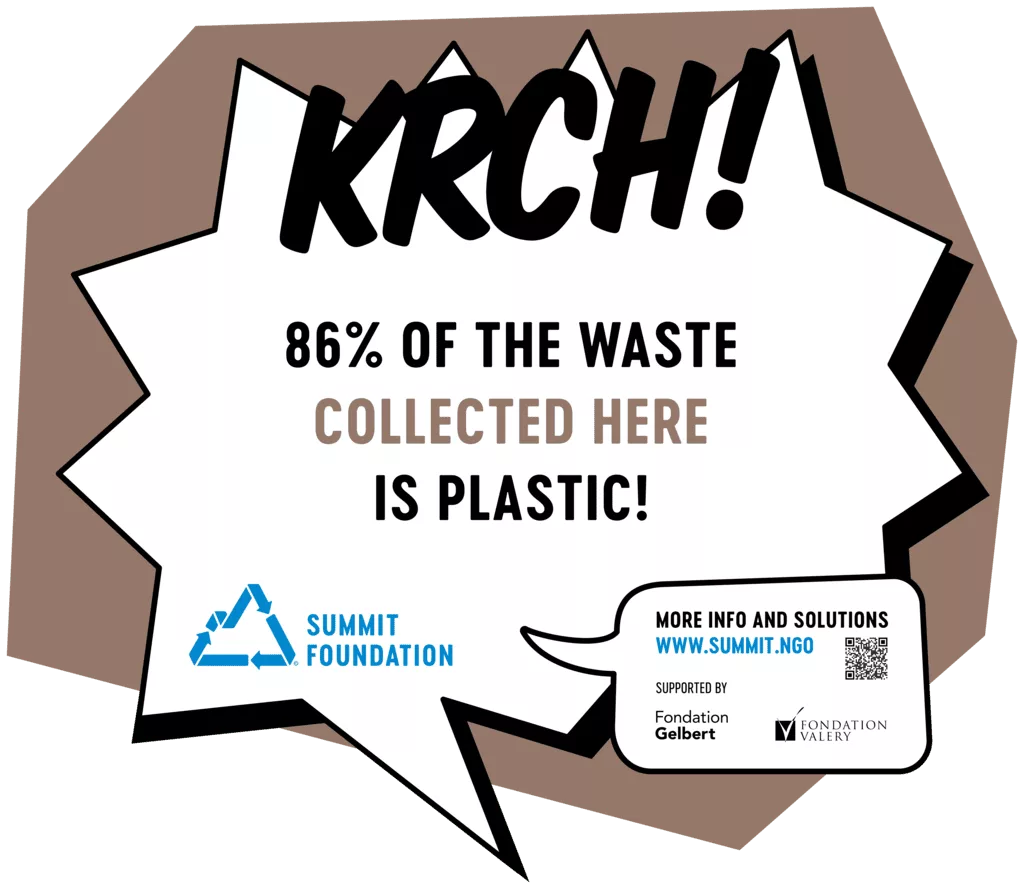
• In Switzerland, 14,000 tonnes of plastic end up in the environment each year.
• 86% of the waste found along the shores of lakes and rivers is plastic.
EXPLANATIONS
Switzerland is a major consumer of plastic. It consumes approximately 1 million4 tonnes per year, or 120 kilograms per capita. This high consumption generates a substantial amount of waste. Each year, 790,000 tonnes5 of plastic are discarded in Switzerland. Half of this volume consists of short-lived items (lasting less than a year), mainly packaging
Although most plastic is disposed of correctly, a significant proportion ends up in the environment: 14,000 tonnes per year6! Most of this comes from tyre wear (8,900 tonnes per year), in the form of microplastics. Another major source is littering, meaning the abandonment of waste (particularly packaging) in the natural environment. Every year in Switzerland, 2,700 tonnes7 of plastic end up in the environment through littering, costing local authorities CHF 200 million. A study8 conducted by the Hammerdirt Foundation and the FOEN, with contributions from Summit Foundation, shows that 86% of the waste collected along lakeshores and waterways is plastic.
The release of plastic into the environment is harmful. Plastic is not biodegradable9 and can remain in the environment for decades or even centuries. Plastics can also be a source of persistent organic pollutants 10(POPs) through the additives they contain. Furthermore, they are harmful to wildlife11, which can ingest them, become trapped in plastic waste or suffocate as a result.
To reduce the amount of plastic entering the environment, adopt the following habits!
- Reduce the use of plastic packaging and make sure it is recycled or disposed of properly.
- When hiking, bring a bag for your waste, choose reusable containers, and a reusable water bottle instead of disposable bottles.
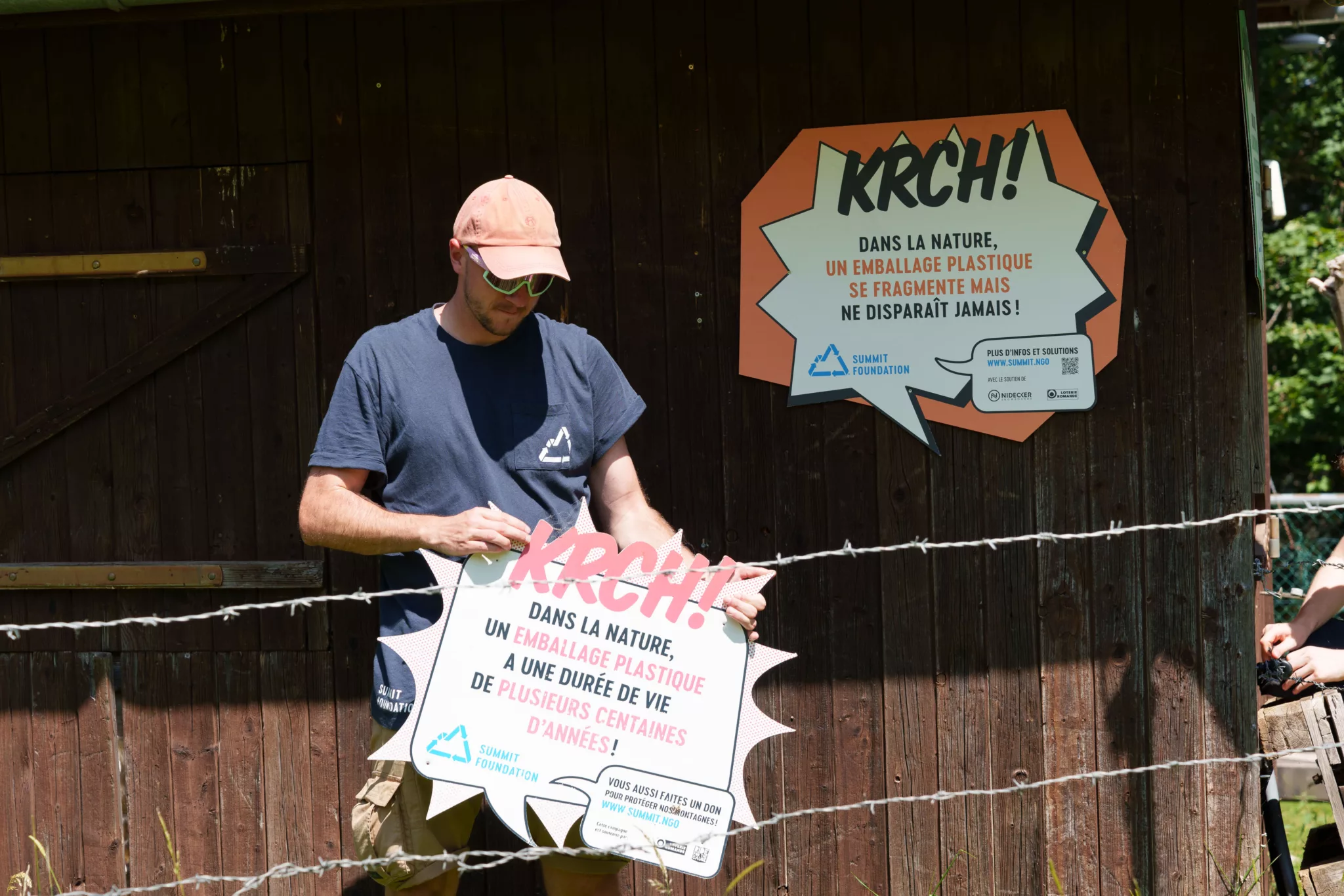
The "KRCH!" Bubble in action
SOURCES
- Garcês, Andreia, and Isabel Pires. «The Detrimental Impacts of Plastic Pollution on Wildlife.» Research in Ecology, 20 May 2024, 42- https://doi.org/10.30564/re.v6i2.6294.
- Our World in Data. «Global Plastic Production with Projections.» Accessed 15 September 2025. https://ourworldindata.org/grapher/global-plastic-production-projections?form=MG0AV3.
- Our World in Data. «Global Plastic Production with Projections.» Accessed 15 September 2025. https://ourworldindata.org/grapher/global-plastic-production-projections?form=MG0AV3.
- FOEN, Federal Office for the Environment. «Plastic materials.» Accessed 10 September 2025. https://www.bafu.admin.ch/bafu/fr/home/themen/thema-abfall/abfallwegweiser--stichworte-a--z/kunststoffe.html.
- FOEN, Federal Office for the Environment. «Plastic materials.» Accessed 10 September 2025. https://www.bafu.admin.ch/bafu/fr/home/themen/thema-abfall/abfallwegweiser--stichworte-a--z/kunststoffe.html.
- FOEN, Federal Office for the Environment. «Plastics in the environment.» Accessed 10 September 2025. https://www.bafu.admin.ch/bafu/fr/home/themen/thema-abfall/abfallpolitik-und-massnahmen/kunststoffe-in-umwelt.html.
- FOEN, Federal Office for the Environment. «Plastics in the environment.» Accessed 10 September 2025. https://www.bafu.admin.ch/bafu/fr/home/themen/thema-abfall/abfallpolitik-und-massnahmen/kunststoffe-in-umwelt.html.
- FOEN, Federal Office for the Environment. «Waste along Swiss lakes and watercourses.» Accessed 12 September 2025. https://www.bafu.admin.ch/bafu/fr/home/themen/thema-abfall/abfall--dossiers/littering-schweizer-gewaesser.html.
- Avio, Carlo Giacomo, Stefania Gorbi, and Francesco Regoli. «Plastics and Microplastics in the Oceans: From Emerging Pollutants to Emerged Threat.» Marine Environmental Research 128 (July 2017): 2- https://doi.org/10.1016/j.marenvres.2016.05.012.
- Gateuille, David, and Emmanuel Naffrechoux. «Transport of Persistent Organic Pollutants: Another Effect of Microplastic Pollution?» WIREs Water 9, no.o 5 (2022): e1600. https://doi.org/10.1002/wat2.1600.
- Garcês, Andreia, and Isabel Pires. «The Detrimental Impacts of Plastic Pollution on Wildlife.». Research in Ecology, 20 May 2024, 42-46. https://doi.org/10.30564/re.v6i2.6294.