
WORKING FOR
CLEANER MOUNTAINS

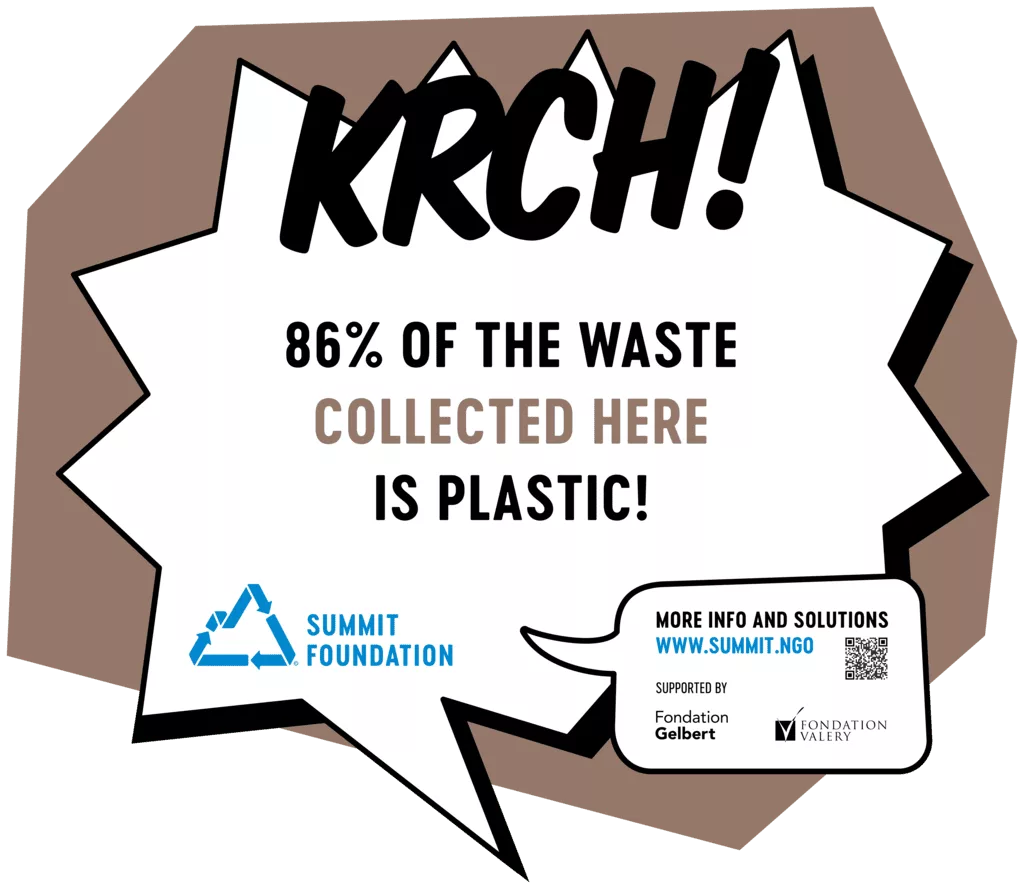
Krch! Bubble

• The Swiss consume one million tonnes of plastic every year.
• In Switzerland, 14,000 tonnes of plastic end up in the environment every year.
• 86% of the waste found along lakes and rivers is made of plastic.

Explanations

Plastic refers to a wide range of synthetic materials. It is generally derived from petroleum or other fossil fuels. Plastic is found in all sectors of activity and is one of the most widely used materials in the world1. For the year 2024, global plastic production is estimated to exceed 500 million tonnes2! This figure could double by 2050, surpassing one billion tonnes3 produced annually.

Switzerland is a major consumer of plastic, using around 1 million4 tonnes per year — equivalent to 120 kilograms per person. This high consumption results in a large amount of waste. Each year, 790,000 tonnes5 of plastic are discarded in the country. Half of this amount consists of short-lived products (less than one year), mainly packaging.

While most plastic is properly disposed of, a significant fraction still ends up in the environment: 14,000 tonnes per year6! The majority comes from tire abrasion (8,900 tonnes per year) in the form of microplastics. Another major source is littering — the abandonment of waste (especially packaging) in nature. Each year in Switzerland, 2,700 tonnes7 of plastic enter the environment through littering, costing municipalities 200 million francs. A study8 conducted by the Hammerdirt Foundation and the FOEN, with contributions from Summit Foundation, shows that 86% of the waste collected along lakes and rivers is plastic.

The release of plastics is harmful to the environment. Plastic is not biodegradable9; it can remain in the environment for decades or even centuries. Plastics are also sources of persistent organic pollutants10 (POPs) through the additives they contain. Furthermore, they are harmful to wildlife11, which can ingest them, become trapped in plastic waste, and even suffocate because of them.

To reduce the amount of plastic in the environment, adopt the following behaviors!

  • Reduce your use of plastic packaging and make sure it is properly recycled or disposed of.
  • When hiking, take a bag for your waste and choose reusable containers and a water bottle instead of disposable ones.

Let’s act together against plastic pollution.
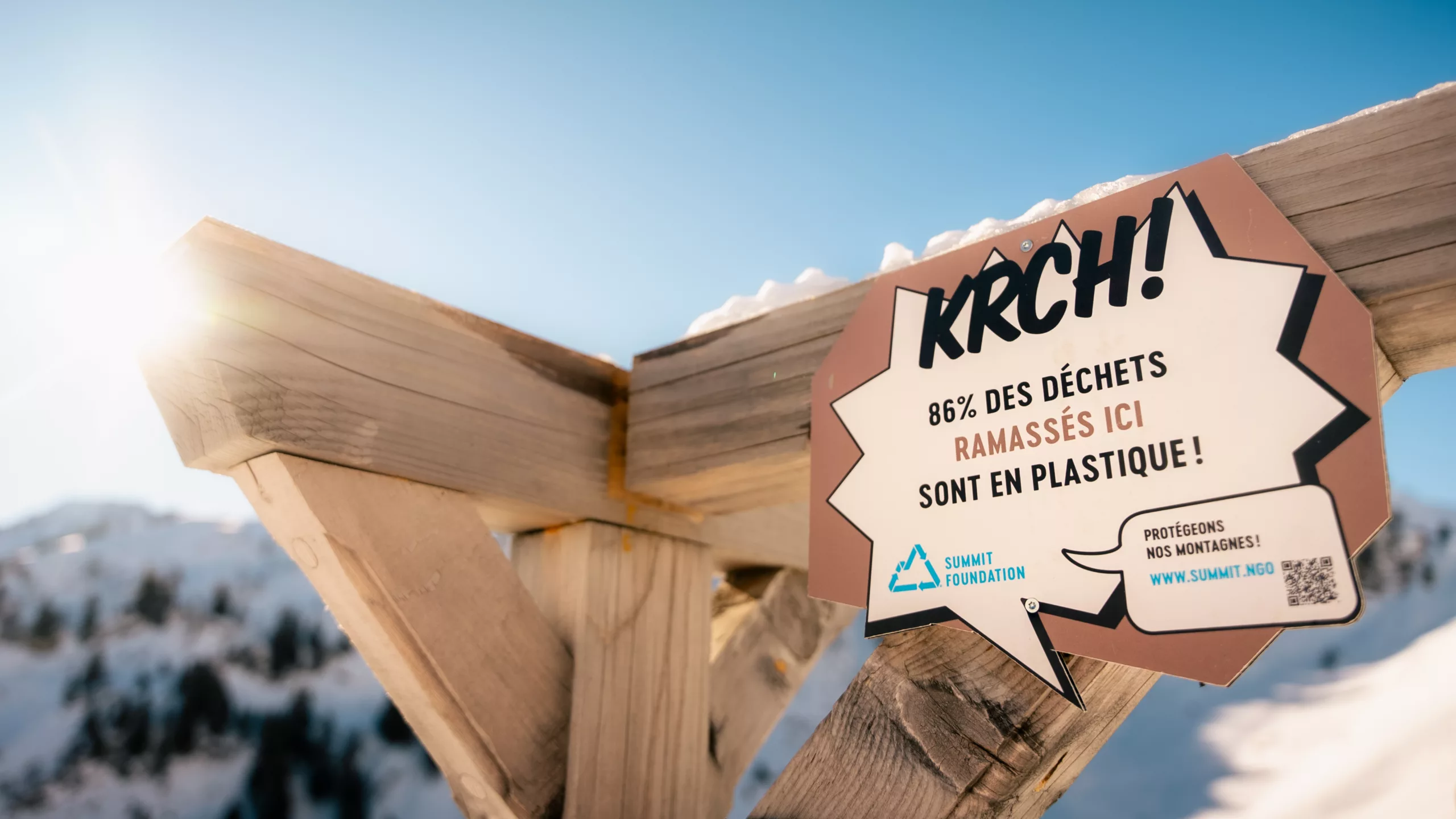
The Krch bubble! In action

Sources

  1. Garcês, Andreia, and Isabel Pires. «The Detrimental Impacts of Plastic Pollution on Wildlife». Research in Ecology, 20 May 2024, 42-. https://doi.org/10.30564/re.v6i2.6294.
  2. Our World in Data. «Global Plastic Production with Projections. Accessed on 15 September 2025. https://ourworldindata.org/grapher/global-plastic-production-projections?form=MG0AV3.
  3. Our World in Data. «Global Plastic Production with Projections. Accessed on 15 September 2025. https://ourworldindata.org/grapher/global-plastic-production-projections?form=MG0AV3.
  4. FOEN, Federal Office for the Environment. «Plastics». Accessed on 10 September 2025. https://www.bafu.admin.ch/bafu/fr/home/themen/thema-abfall/abfallwegweiser--stichworte-a--z/kunststoffe.html.
  5. FOEN, Federal Office for the Environment. «Plastics». Accessed on 10 September 2025. https://www.bafu.admin.ch/bafu/fr/home/themen/thema-abfall/abfallwegweiser--stichworte-a--z/kunststoffe.html.
  6. FOEN, Federal Office for the Environment. «Plastics in the environment». Accessed on 10 September 2025. https://www.bafu.admin.ch/bafu/fr/home/themen/thema-abfall/abfallpolitik-und-massnahmen/kunststoffe-in-umwelt.html.
  7. FOEN, Federal Office for the Environment. «Plastics in the environment». Accessed on 10 September 2025. https://www.bafu.admin.ch/bafu/fr/home/themen/thema-abfall/abfallpolitik-und-massnahmen/kunststoffe-in-umwelt.html.
  8. FOEN, Federal Office for the Environment. «Waste around Swiss lakes and rivers». Accessed on 12 September 2025. https://www.bafu.admin.ch/bafu/fr/home/themen/thema-abfall/abfall--dossiers/littering-schweizer-gewaesser.html.
  9. Avio, Carlo Giacomo, Stefania Gorbi, and Francesco Regoli. «Plastics and Microplastics in the Oceans: From Emerging Pollutants to Emerged Threat». Marine Environmental Research 128 (July 2017): 2- https://doi.org/10.1016/j.marenvres.2016.05.012.
  10. Gateuille, David, and Emmanuel Naffrechoux. «Transport of Persistent Organic Pollutants: Another Effect of Microplastic Pollution?» WIREs Water 9, no 5 (2022): e1600. https://doi.org/10.1002/wat2.1600.
  11. Garcês, Andreia, and Isabel Pires. «The Detrimental Impacts of Plastic Pollution on Wildlife. Research in Ecology, 20 May 2024, 42-46. https://doi.org/10.30564/re.v6i2.6294.
linkedin facebook pinterest youtube rss twitter instagram facebook-blank rss-blank linkedin-blank pinterest youtube twitter instagram
Summit Foundation
Résumé de la politique de confidentialité

Ce site utilise des cookies afin que nous puissions vous fournir la meilleure expérience utilisateur possible. Les informations sur les cookies sont stockées dans votre navigateur et remplissent des fonctions telles que vous reconnaître lorsque vous revenez sur notre site Web et aider notre équipe à comprendre les sections du site que vous trouvez les plus intéressantes et utiles.