

CLEANER MOUNTAINS
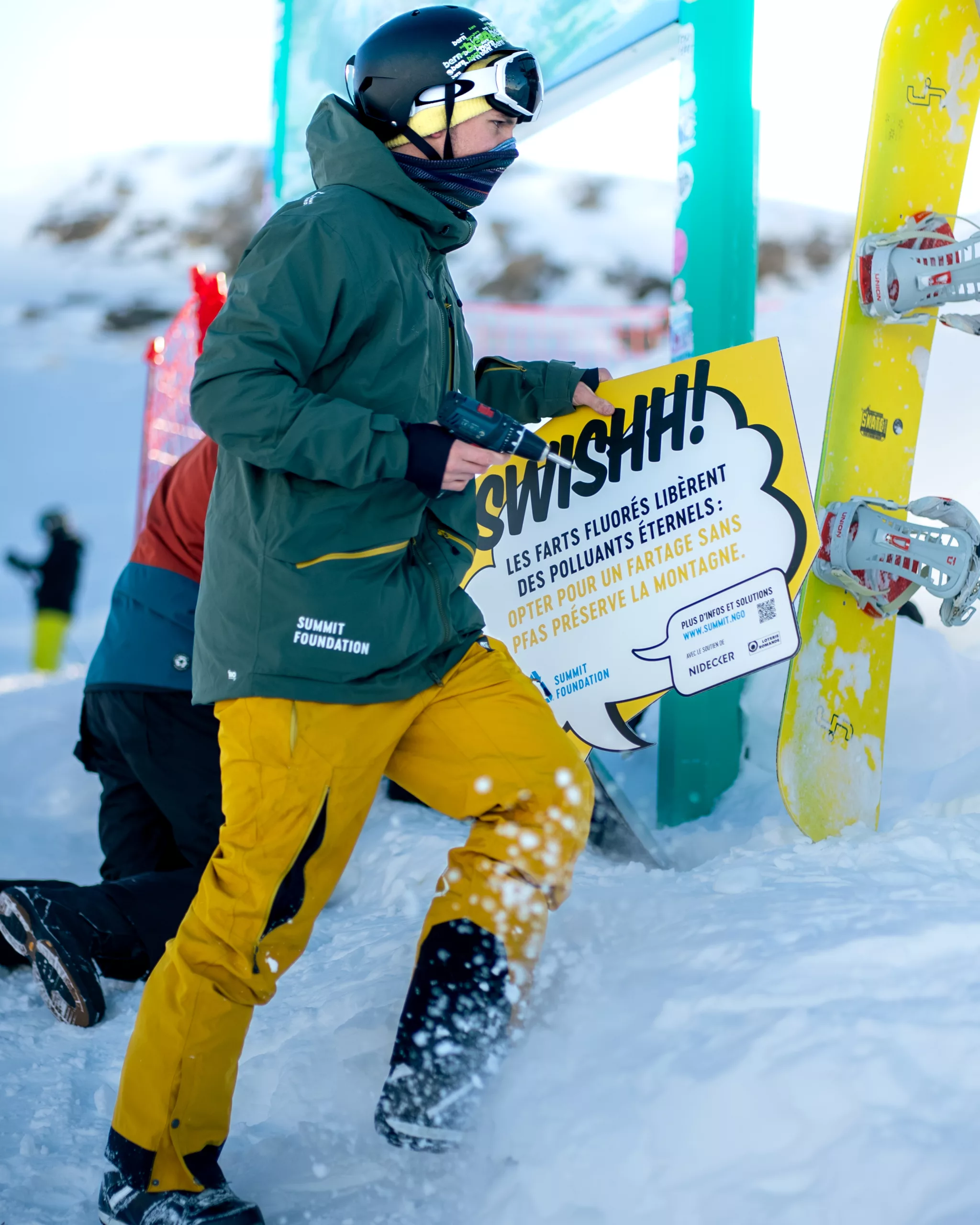
"SWISHH!" BUBBLE
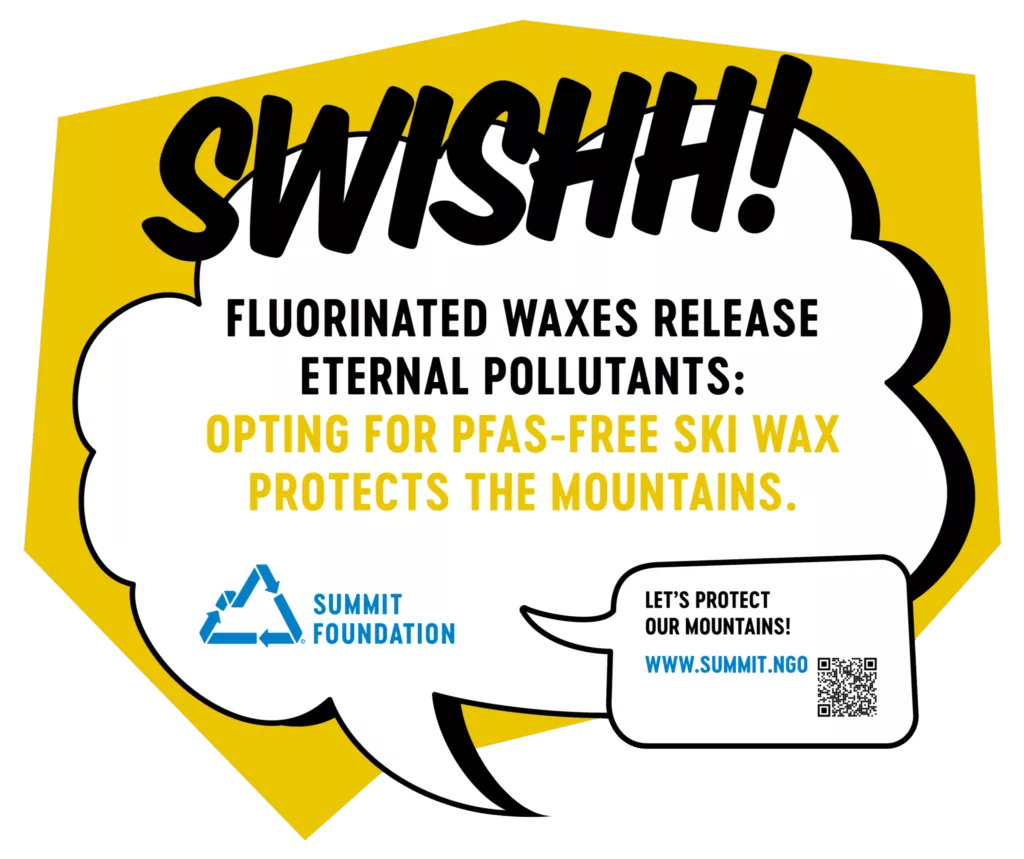
• They are persistent in the environment and harmful to wildlife and human health.
• PFAS are found in ski waxes. They end up in the environment through ski abrasion.
EXPLANATIONS
PFAS (per- and polyfluoroalkyl substances) refers to a family of more than 10,000 synthetic molecules¹. They consist of chains of carbon and fluorine atoms of varying lengths. These molecules are valued for their properties², including non-stick, waterproofing and surfactant properties, as well as their heat resistance and chemical stability. PFAS are used in numerous industrial processes and everyday products³ (for example, frying pans and waterproofing agents). One of these applications is ski waxing. Fluorinated ski waxes are known to improve gliding performance⁴.
However, PFAS are harmful to the environment and human health⁵. PFAS are known as forever chemicals because, due to their chemical stability, they persist in the environment. PFAS can enter organisms through various pathways. The main route is oral exposure, particularly through water, food and breast milk for young children. Exposure can also occur through skin contact or inhalation. PFAS have toxic effects⁶ on humans (and also on animals). The list is long, but some of the effects include carcinogenicity, immunotoxicity, reduced birth weight in babies and endocrine disruption.
Skiing is therefore a source of PFAS pollution. During waxing, 80% of the product⁷ is lost, which can be problematic if it is not disposed of properly and can also lead to PFAS exposure through inhalation. The remaining 20% can end up in the environment during skiing through abrasion of the skis. Studies have shown a higher presence of PFAS in ski areas⁸ than in non-ski areas. A report⁹ produced by EPFL in collaboration with Summit Foundation highlighted the presence of PFAS in Swiss ski resorts.
Although the FIS (International Ski and Snowboard Federation) has banned fluorinated ski waxes from competitions¹⁰, they are still available to the general public. So, ask your sports shop about using a PFAS-free ski wax. In addition, if you wax your skis yourself, remember to wear a mask to avoid inhaling harmful particles.
PFAS are harmful to nature and our health; let’s take collective action to eliminate them from our environment.
TAKE A LOOK AT OUR STUDY
OUR STUDYWHICH WAXES TO USE?
That is why the Foundation recommends the Isantin wax, developed by former ETH Zurich chemist Peter Bützer. Its formula, fully public and based on indigo, a plant derived dye, makes it a safer and more environmentally friendly alternative.
Other brands also offer interesting options, including mountainFLOW (United States) and NZERO (Spain), which sell waxes made exclusively from plant based ingredients.
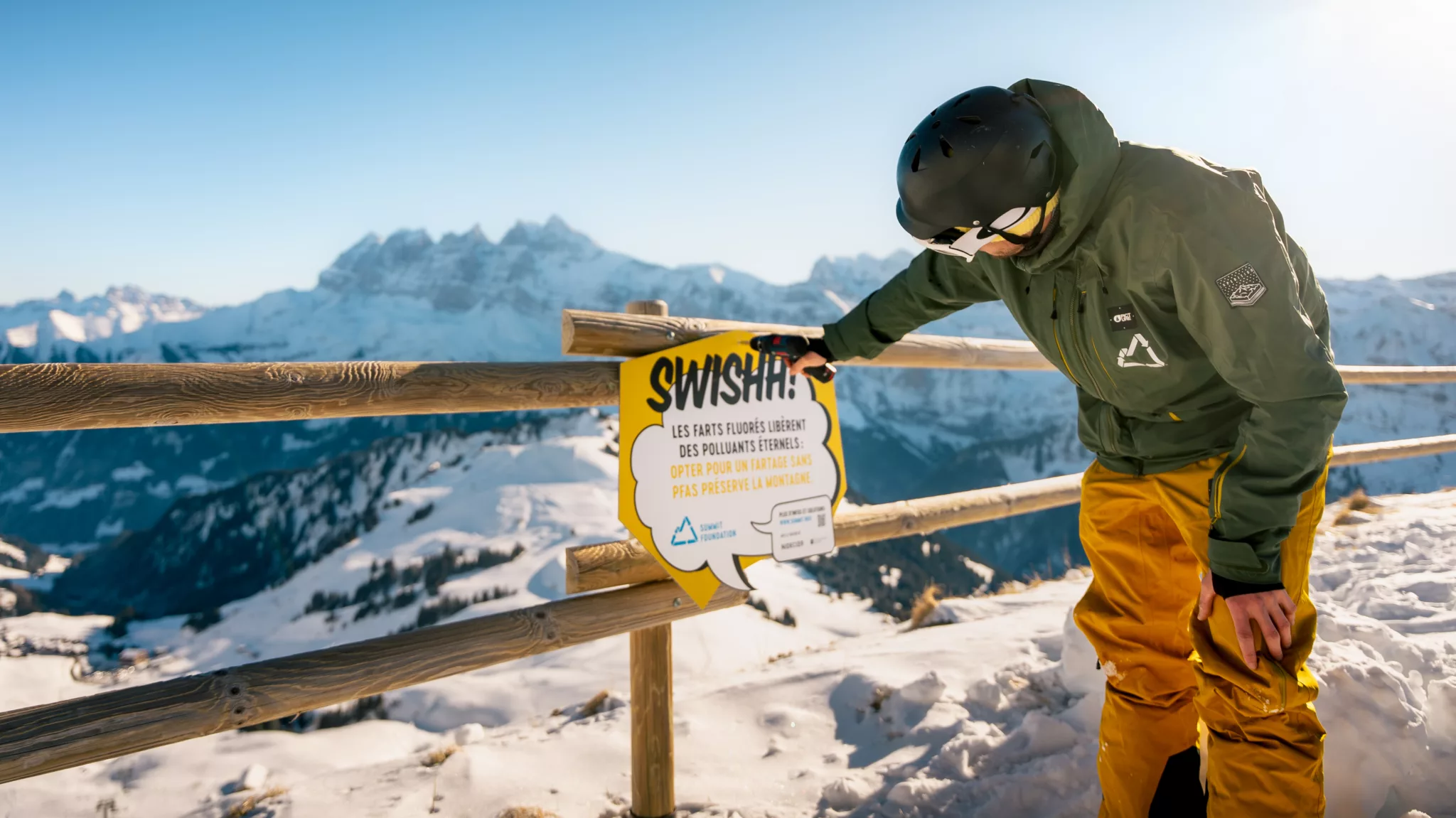
The “Swishh!” bubble in action
SOURCES
- Gaillard, Lucas, Kévin Bernal, Xavier Coumoul, Karine Andréau, and Etienne B. Blanc. «Forever Pollutants and Human Contamination: Current Status and Issues Concerning Per- and Polyfluoroalkyl Substances (PFAS).» Cahiers de Nutrition et de Diététique 59, no. 6 (2024): 349- https://doi.org/10.1016/j.cnd.2024.10.003 .
- Gaillard, Lucas, Kévin Bernal, Xavier Coumoul, Karine Andréau, and Etienne B. Blanc. «Forever Pollutants and Human Contamination: Current Status and Issues Concerning Per- and Polyfluoroalkyl Substances (PFAS).» Cahiers de Nutrition et de Diététique 59, no. 6 (2024): 349- https://doi.org/10.1016/j.cnd.2024.10.003 .
- OFEV, Federal Office for the Environment. «PFAS, What Are They?» Accessed September 18, 2025. https://www.bafu.admin.ch/bafu/fr/home/themen/thema-chemikalien/chemikalien--dossiers/pfas-per-und-polyfluorierte-alkylverbindungen.html .
- Bouchex-Bellomie, Harold, and Andreas Buser. Use of Fluorinated Ski Waxes in Switzerland. 2025. https://www.bafu.admin.ch/dam/bafu/fr/dokumente/chemikalien/fachinfo-daten/Bericht%20Skiwachs.pdf.download.pdf/Rapport_farts_de_ski.pdf .
- OFEV, Federal Office for the Environment. «PFAS, What Are They?» Accessed September 18, 2025. https://www.bafu.admin.ch/bafu/fr/home/themen/thema-chemikalien/chemikalien--dossiers/pfas-per-und-polyfluorierte-alkylverbindungen.html .
- Gaillard, Lucas, Kévin Bernal, Xavier Coumoul, Karine Andréau, and Etienne B. Blanc. «Forever Pollutants and Human Contamination: Current Status and Issues Concerning Per- and Polyfluoroalkyl Substances (PFAS).» Cahiers de Nutrition et de Diététique 59, no. 6 (2024): 349-61. https://doi.org/10.1016/j.cnd.2024.10.003 .
- Bouchex-Bellomie, Harold, and Andreas Buser. Use of Fluorinated Ski Waxes in Switzerland. n.d. https://www.bafu.admin.ch/dam/bafu/fr/dokumente/chemikalien/fachinfo-daten/Bericht%20Skiwachs.pdf.download.pdf/Rapport_farts_de_ski.pdf .
- Müller, Viktoria, Larissa Cristine Andrade Costa, Filipe Soares Rondan, et al. «Per and Polyfluoroalkylated Substances (PFAS) Target and EOF Analyses in Ski Wax, Snowmelts, and Soil from Skiing Areas.» Environmental Science: Processes & Impacts 25, no. 12 (2023): 1926- https://doi.org/10.1039/D3EM00375B .
- Bossi, Beatrice, and Manon Bernard. https://www.epfl.ch/schools/enac/education/environmental-sciences-and-engineering/wp-content/uploads/2025/06/Poster-DP-25.pdf
- Bouchex-Bellomie, Harold, and Andreas Buser. Use of Fluorinated Ski Waxes in Switzerland. 2025. https://www.bafu.admin.ch/dam/bafu/fr/dokumente/chemikalien/fachinfo-daten/Bericht%20Skiwachs.pdf.download.pdf/Rapport_farts_de_ski.pdf .